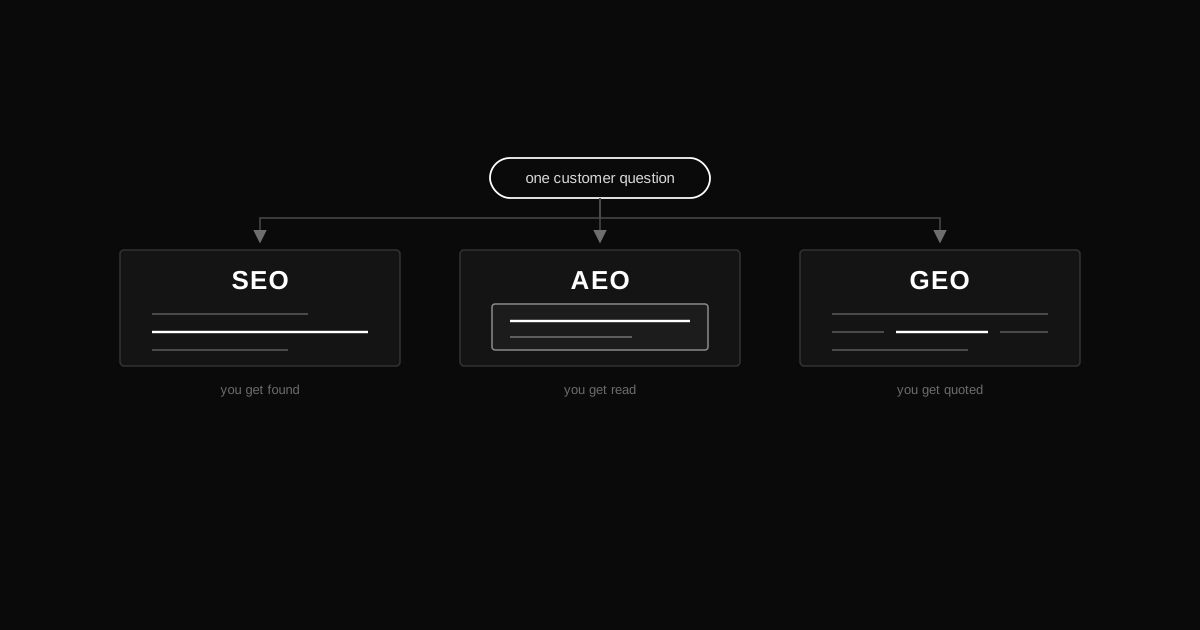
SEO, AEO, GEO — Search Split Into Three. Here's What a Business Actually Does About It
TL;DRSearch split into three jobs. SEO ranks your page in a list of links. AEO makes your page the answer shown at the top. GEO gets your business mentioned inside an AI assistant's written answer. They share one foundation: pages a machine can read, questions answered in the first two sentences, and the same facts about you everywhere you appear.
…
What's the difference between SEO, AEO and GEO?
SEO is optimizing to rank in a list of links so someone clicks through to your site. AEO is optimizing to be the answer shown directly on the results page or read out by a voice assistant. GEO is optimizing to be mentioned inside the answer an AI assistant writes when someone asks it a question. Found, read, quoted.
Is SEO dead now that people use AI assistants?
No. AI assistants read the same web that search engines crawl, so a page that isn't crawlable, fast, or clearly written can't be quoted either. SEO is the foundation the other two are built on — you're adding layers, not replacing them.
How does a small business start with AEO and GEO?
Write down the real questions customers ask you, give each one its own page, and answer it plainly in the first two sentences. Then make sure your name, description, prices, hours and contact details say the exact same thing on your site, your maps listing, your directory profiles and your social pages.
How do I know if AI assistants are recommending my business?
Ask them. Once a month, type your customers' top ten questions into the assistants they use and note whether you're mentioned and what's said about you. That check is the new rank tracker — rankings alone no longer tell you the whole story.
Share
For twenty years, getting found meant one thing: rank on Google, get the click. That's still true — it's just no longer the whole story. A growing share of your customers now type the same question into ChatGPT, Perplexity, or the AI box sitting on top of the search results, read the answer, and never click anything at all. If your business isn't in that answer, you didn't lose to a competitor who ranked higher. You just weren't in the room.
Search didn't die. It split into three, and each part rewards something different.
Three letters, three jobs
SEO — search engine optimization. The classic one. You want your page to appear in a list of links so somebody clicks it and lands on your site. It rewards pages a crawler can read, a topic you clearly cover in depth, other credible sites linking to you, and a page that loads fast. The prize is a visit.
AEO — answer engine optimization. Here you're not competing for a link, you're competing to be the answer: the box at the top of the results, the "people also ask" panel, the sentence a voice assistant reads out loud. It rewards asking the question your customer actually asks — in their words — and answering it in the first two sentences, plainly, with no wind-up. The prize is being the sentence everyone sees, whether or not they click.
GEO — generative engine optimization. The new one. When someone asks an assistant "who does X near me" or "what's the best tool for Y", the assistant doesn't hand back a list — it writes an answer and names a handful of businesses inside it. GEO is the work of being one of the businesses it names. It rewards being easy to quote, factually consistent everywhere you appear, and unmistakably the thing you claim to be. The prize is a mention inside somebody else's answer.
Same customer, same question, three different front doors.
What actually changed: the click became optional
The old deal was simple — the search engine found your page, and to actually get the information, the customer had to come to you. That trip is now optional. The answer gets assembled and delivered somewhere else, and you may never see the visit in your analytics.
That has one big consequence for how you write: you are no longer only optimizing to be visited. You're optimizing to be quoted. A page that only makes sense to someone who's already reading it, in order, on your site, is a page that travels badly. A page built out of clear, self-contained, factual statements gets lifted into other people's answers — and your name travels with it.
The good news: it's mostly one pile of work
Three names, one foundation. An AI assistant reads the same web a search crawler does. If your page is slow, blocked, buried in JavaScript, or vague about what it's for, it can't be ranked or quoted. So don't throw away your SEO to chase the new letters — stack them in this order:
SEO first — make the page reachable, readable and genuinely about one thing.
AEO on top — restructure so the answer comes first and the explanation comes after.
GEO on top of that — make your facts consistent everywhere, so an assistant can repeat them without hedging.
Each layer makes the one below it work harder. None of them replaces the one below it.
How a business actually implements this
Six moves, in the order they pay off:
Start with questions, not keywords. Ask whoever talks to customers to write down every question they get asked in a week — pricing, delivery, "do you do X", "how is this different from Y". That list is your content plan. Keywords are a guess at what people type; these are the actual words.
Answer in the first two sentences. Put the answer at the top, then explain underneath. And write the answer so it survives being copied out of the page on its own: "A same-day delivery in Kuwait City costs…", not "It depends — read on." Anything that starts with "we" or "it" loses its meaning the moment it's quoted somewhere else.
One page, one question. A single 3,000-word page covering ten topics competes for nothing. Ten focused pages, each answering one question completely, can each become the answer to that question. Split, don't pile.
Hand over your facts in a form nothing can misread. Prices, opening hours, service areas, contact details, delivery times — as plain text on the page, not baked into an image, a PDF, or a design element. Add structured data (the machine-readable summary of your business, products and FAQs) so there's no interpretation involved. If a fact matters to a buying decision, a machine should be able to read it without guessing.
Say the same thing everywhere. Your website, your maps listing, your directory profiles, your social bios — same business name, same category, same description, same phone number. Assistants assemble answers from what several sources agree on. Contradictions don't make you look mysterious; they make you the risky option to mention, so you get left out in favour of a competitor whose story is boring and consistent.
Decide, on purpose, whether the AI crawlers are welcome. They're a separate set of crawlers from the search engines, and your site can allow or block them. Blocking them is a legitimate choice — but it is a choice to not be quoted. Most businesses that want to be recommended should let them in, and should check today which setting they're actually on. Very few people have ever looked.
What to stop doing
Burying the answer in paragraph nine so people "spend time on the page." That time is now spent somewhere else entirely.
Padding for length. Long doesn't win anymore; complete and clear does.
Keeping your important facts only inside images, videos or PDFs.
Telling a slightly different story on every platform because each one was written by a different person in a different year.
Writing for the algorithm instead of the customer. Every one of the three letters is now, in practice, rewarding the same thing: a clear answer to a real question, from a source that's consistent about who it is.
How you'll know it's working
Rankings alone stopped telling the truth, so add two habits:
Ask the assistants yourself, once a month. Type your customers' top ten questions into the assistants they actually use. Are you mentioned? Is what's said about you correct? Save the answers — that log is your new rank tracker, and it shows you exactly which facts about you are wrong out there.
Watch for visitors who arrive already convinced. When traffic drops but enquiries stay steady — or people show up knowing your prices without ever browsing your site — you're being quoted upstream. That's GEO working, and it will never look like a good number in your traffic report.
The one-line version: SEO gets you found. AEO gets you read. GEO gets you quoted. Do them in that order, on the same pile of work.
How this connects to the rest of the setup
This isn't a separate discipline you bolt on — it's a job the AI setup in this series is already shaped to do:
Keep the customer-question list in your vault, so the content plan is a living document instead of a one-off workshop.
Write the answer-first check once as a skill — "does this page answer the question in the first two sentences, in a sentence that survives being quoted?" — and stop re-explaining the standard.
Put "every published page answers one question, answer first" in your rules file, so it applies without you asking.
Send subagents across every existing page to find the ones that bury the answer, and let MCP tools read the live site instead of guessing at it.
End the pass with "update memory" so each wrong fact you find out in the world gets fixed once, everywhere.
That's the difference between doing an SEO project and having a setup that keeps you quotable by default.
 AI FROM MY POV