Build a Memory Pipeline So Your AI Stops Forgetting You
TL;DRYour AI forgets everything between sessions — that's not a bug, it's how sessions work. Fix it with a loop: end each session by telling Claude to save what you learned as small, one-lesson files, keep a one-line index of them, and load that index at the start of the next session. Then wire that same save to update your vault and graph in the same pass, so one command keeps all three current. Two habits, and your setup gets smarter every time you use it.
…
Do I need Obsidian for this?
No. A plain folder of Markdown files works fine. If you already set up the vault from episode 01, even better — just add a memory/ folder inside it and everything you already know about that vault applies.
Won't Claude re-read hundreds of files every session and get slow?
That's exactly what the index is for. Claude reads one line per lesson, not the whole file — it only opens the full file when that lesson is actually relevant to what you're doing.
What's actually worth saving?
Mistakes you don't want repeated, decisions with a reason behind them, and patterns that worked. Not routine work — if nothing would've gone differently next time, skip it.
Do I need any special tool or plugin for this?
No. Just Claude (Code or desktop) and plain files. It's the same two ingredients as episode 01 — you're just using them for a different job.
Every new session, your AI starts blank. It doesn't remember the bug you fixed yesterday, the decision you made twenty minutes ago in a different chat, or the thing that annoyed you about its last answer. That's not a Claude problem — that's how a session works. Nothing carries over unless you carry it over. The fix isn't a smarter model. It's a loop: write down what you learned, and load it back in next time. Two small habits, and your AI stops resetting and starts compounding.
Why does your AI forget everything?
A session is a blank page. Even the best AI in the world has no idea what happened in your last conversation unless something outside that conversation tells it. So you end up re-explaining the same context, watching it make the same mistake twice, or re-deciding something you already settled last week. The AI isn't bad at remembering — it was never given anything to remember. That's the actual gap, and it's fixable with files, not a better model.
What's the fix, in one sentence?
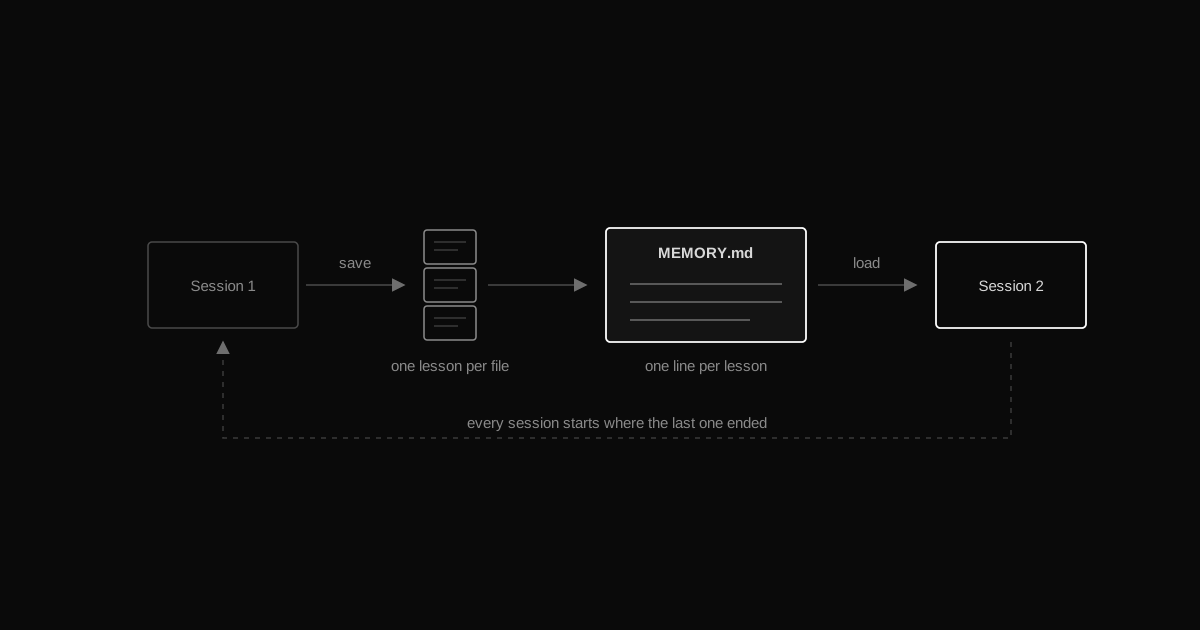
A memory loop: save what you learned into small files after each session, keep a one-line index of them, and load that index at the start of the next session. That's it — two habits, no special software.
Step 1 — Save what you learned
At the end of a session, tell Claude to write it down. Not a wall of text — small, single-purpose files, one lesson per file, each with a short why and a short how to apply.
Save what we learned this session to memory/:- One file per lesson, named memory/lesson-<short-slug>.md- Each file: a one-line title, a short "why" (what happened / what we found out), and a short "how to apply" (what to do differently next time)- Keep each file short — a few lines, not an essay- Add one line for each new lesson to memory/MEMORY.md, the index
Claude writes the files and updates the index in the same pass. You don't organize anything — you just say "save this" at the end of whatever you were doing.
Step 2 — Keep a one-line index
memory/MEMORY.md is the whole trick. One line per lesson, nothing more:
- [Retry webhook calls with backoff] — see lesson-webhook-retry.md- [Never trust user input in the search query] — see lesson-search-input.md- [Client wants Friday deploys, not Thursday] — see lesson-deploy-day.md
The index is cheap to read in full every session. The individual lesson files are not — that's why they stay separate. Claude scans the index, spots what's relevant, and only opens the full file when it needs the detail.
Step 3 — Load it at the start of the next session
This is the step people skip, and it's the one that actually closes the loop. At the start of a new session:
Read memory/MEMORY.md first, then let's continue.
Now Claude walks in already knowing what you both figured out last time — instead of you re-explaining it, or it re-making the same call. (Episode 04 covers wiring this into your rules file so it happens automatically, without you typing it every time — for now, the one-line prompt does the job.)
Make one save update all three layers
By now three things exist side by side: a vault of notes (episode 01), a graph of how they connect (episode 02), and a memory folder of lessons. The mistake is treating those as three separate chores at the end of a session. They should be one command.
Add this to the same end-of-session prompt:
When I say "update memory", do all three in one pass:1. Write the new lesson to memory/ and add its line to memory/MEMORY.md2. Mirror it into the vault as a note, with [[wikilinks]] to the notes it actually relates to3. Refresh graph/index.md so the new note's links show up in the mapThen tell me what you wrote and what it linked to.
Now "update memory" isn't only a memory write — it's the whole brain updating at once. The lesson is saved, it sits in the vault next to everything else you've written, and the graph knows how it connects to the rest. Skip the vault and graph steps and your lessons quietly rot in a folder nothing ever reads.
And the reason this is one command instead of three: you will actually do a one-word habit at the end of every session. You will not do a three-step chore.
Why it matters
Without this loop, every session is a fresh hire: capable, but starting from zero, repeating whatever mistake you already caught last week. With it, your AI behaves like someone who's actually been on the project — it stops suggesting the thing you already ruled out, it applies the fix you already found, and every session makes the next one slightly better instead of identical to the last. That's the real payoff: not a bigger model, just a setup that remembers for you.
It also sets up the next two pieces of this series: once you're saving real lessons this way, the graph pattern from episode 02 is what lets your AI find the right lesson fast once you have hundreds of them, and episode 04 is what makes loading the index automatic instead of a habit you have to remember. Start with the loop — the rest builds on top of it.
How this connects to the rest of the setup
The loop above already wires memory into the vault and the graph. The pieces after it are what make the loop run itself:
A rules file loads the memory index at the start of every session, so step 3 stops being a habit you have to remember.
Skills can end with "update memory" as a step, so any packaged workflow saves its own lessons.
Subagents report back to the main thread, and what they found is worth saving the same way.
Three pieces in, and they've stopped being separate. The full setup is the whole picture.
 AI FROM MY POV