Your Employer Wants an AI Certificate — Which One, for Every Job
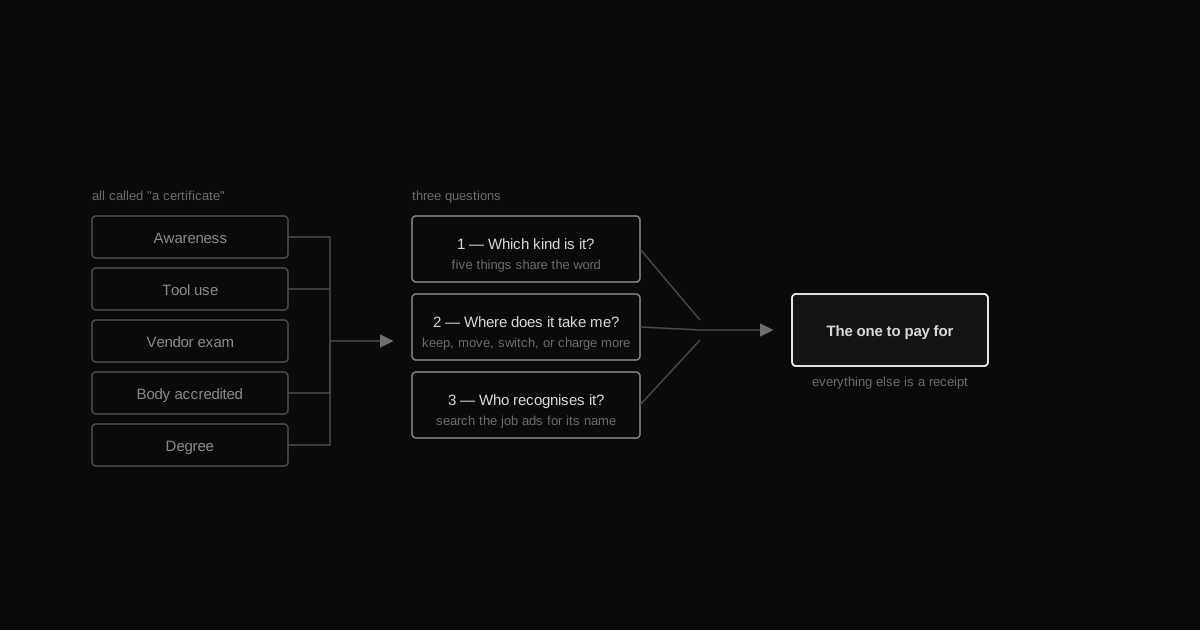
TL;DRFive completely different things are sold under the word 'certificate': awareness, tool use, a proctored vendor exam, a credential accredited by your professional body, and a degree. Most people buy the first and expect the third. Ask three questions before you pay — which kind is this, where am I trying to get, and does the person who employs me recognise it — then pick from the list by profession. The honest finding after checking every field: in medicine, engineering, HR and accounting there is a credential with real weight, and in retail, hospitality, logistics and the trades there mostly isn't — what your employer wants there is proof you can use the tools, not paper.
…
My employer told me to get an AI certificate. Which one should I take?
Ask them which one they mean before you buy anything. In most companies the request is vaguer than it sounds, and often there is a specific certificate they have in mind — sometimes one they'll pay for. If they genuinely have no preference, the request is really 'show me you can use these tools', and a short applied course in your own field plus a piece of work you can show does more than an expensive credential nobody named.
Are free AI certificates worth anything?
As proof to an employer, mostly no — a certificate nobody can fail is an attendance record. As a way to learn, several free ones are genuinely good, and free audit on the paid platforms gives you the same lessons without the certificate. Spend nothing on the awareness layer and save your money for a credential that has an exam behind it, if your field has one.
What's the difference between a certificate and a certification?
A certificate says you finished something. A certification says you passed an assessment someone else set, usually proctored, with a verifiable ID an employer can check and an expiry date. AWS, Microsoft, Google, Adobe and the professional bodies issue certifications. Most course platforms issue certificates. Both use the word 'certificate' in their marketing, which is exactly why people overpay for the wrong one.
Which AI certificates do employers actually recognise?
The ones with an exam and a name your industry already knows: AWS Certified AI Practitioner and Microsoft Azure AI Fundamentals for anything technical, Google Skillshop for advertising, Adobe's Firefly certification for creative work, SHRM or HRCI credit for HR, IEEE PDH credits for licensed engineers, CME-accredited courses for doctors, and ISTE certification for teachers. Notice that the weight comes from the body, not the AI content.
Will an AI certificate get me a job?
On its own, almost never — and that's true of certificates generally, not just AI ones. It gets you past a filter, gives you vocabulary in an interview, and shows initiative. What actually gets the job is a piece of work: the thing you built or the process you shortened, with a number attached. If you can only do one, do the work.
I'm not technical at all. Where do I start?
One short literacy course to stop being scared of the tool, then a course about your own job — in that order, and don't spend much on the first. If Arabic is easier for you, AI For Everyone is available with Arabic subtitles. After that, stop taking courses and start using the tools on real work, because the fourth course teaches you less than the first real task does.
How do I check whether a certificate is respected in my field before I pay?
Search job ads in your field for its exact name. Zero mentions in fifty ads means zero leverage. Then check three things: is there an exam you can fail, is the credential verifiable by ID, and does your professional body accredit it. Ten minutes of this saves most of the money people waste on AI courses.
Does my profession even have a real AI course?
Some do and some genuinely don't. Medicine, engineering, law, accounting, teaching, HR and design have credible profession-specific options — several accredited. Retail, hospitality, logistics, driving and most trades don't really, beyond a couple of exceptions like the American Culinary Federation's course for chefs. In those fields nobody is checking for a certificate, so the honest move is to skip the paper and learn the two or three tools your workplace already pays for.
Share
Someone at work says the sentence: "you need to get an AI certificate."
Then you open Google and the internet does what the internet does. Nine hundred courses. Everything is a "professional certificate." Everything is "industry-recognised." Prices from free to four thousand dollars, and no obvious relationship between the price and what you get. So people do the reasonable thing — they buy the one at the top with the most reviews — and three weeks later they own a PDF that changes nothing about their job.
I promised in the video I'd give you the actual list. It's below, by profession, and I checked every course on it. But the list is the second half. The first half is three questions, because the list is useless if you can't tell which of these things you're looking at.
Question 1 — what kind of certificate is this?
Five completely different products are sold under one word. Before anything else, work out which one is in front of you.
Awareness. Explains what AI is, what a model does, what it can't do. Ends with a quiz you cannot fail. It's the right place to start if you're beginning cold — it takes a few hours and it makes the fear go away. Its value to an employer is close to zero, so pay close to zero for it.
Applied, or tool use. Teaches you to do your job with the tools — the marketer's version, the teacher's version, the accountant's version. This is the layer that shows up in your work the same week. Usually cheap, usually a certificate of completion, and by far the best return for most people.
Vendor certification with a proctored exam. Microsoft, AWS, Google, Adobe, NVIDIA. You sit a real exam, you can fail it, the credential has an ID an employer can verify, and it expires. This is the category that appears by name in job ads.
Accredited by the body your field already answers to. CME hours for doctors, PDH or CEU credits for licensed engineers, SHRM or HRCI credit for HR, ISTE for teachers, ACF for chefs. The weight here has nothing to do with the AI content — it comes from the body. If your field has one of these, it usually beats a generic vendor certificate.
Degree-level. A diploma or a master's. Months to years, thousands of dollars, and it changes what you're allowed to apply for. Occasionally the right answer. Almost never the right answer to "my manager asked me to do an AI course."
The trap is that all five are marketed with the same three words: professional, certificate, industry-recognised. The first two mean nothing at all. The third means nothing unless you can name the industry that recognises it.
Question 2 — will it get me where I actually want to go?
Four destinations. Different answers.
I want to keep the job I have. Applied tool-use in your own field. Cheap, short, done. You are not being asked for a credential, you're being asked to stop being the person who does it the slow way.
I want a different role in the same field. Now the certificate has a job to do: get you through a filter. Look at what the role you want actually asks for, and buy that. Not the adjacent thing that was on sale.
I want to change field entirely. This is the one case where a long, expensive, examined credential can be worth it — you have no track record in the new field, so borrowed credibility is all you have. Expect months, not a weekend.
I want to charge more for the same work. Nobody pays more because you have a certificate. They pay more because your output got better or faster. Take the applied course, then do the work, then raise your price with the work in your hand.
Write your destination down before you open a single course page. Most of the money wasted on AI courses is spent by people who never answered this question, so every course looked equally reasonable.
Question 3 — does it qualify me with the person who employs me?
This is the question people skip, and it's the only one with a hard answer. Ten minutes:
Search job ads in your field for the certificate's exact name. Fifty ads, zero mentions, no leverage. This one test kills most of the list.
Ask the person who asked you. "Which one do you mean?" Very often there's a specific one, and very often the company pays for it. It's a strange thing to spend your own money guessing.
Is there an exam you can fail? If not, it's an attendance record. That's fine — just don't pay certification prices for it.
Is it verifiable? A credential ID or badge an employer can check, not a PDF with your name typed into it.
Does your professional body accredit it? If you're a doctor, engineer, accountant, lawyer, teacher or HR professional, your body's opinion outranks any platform's marketing.
One more, and it's the one I'd actually push you towards: what will I have at the end that I can show someone? A certificate is a claim. A rewritten process, a report that used to take a day and now takes an hour, a dataset you cleaned — those are evidence. In every field I checked for this article, the people who got real career movement out of AI had evidence. The certificate was the receipt, not the reason.
Before the list — three things that are true everywhere
The starter course is the same for almost everyone. Google AI Essentials (Coursera, about 8–10 hours, subscription-priced with a free trial) or AI For Everyone by Andrew Ng (Coursera, about 6–7 hours, free to audit). Both are literacy, not skill. AI For Everyone exists in Arabic — الذكاء الاصطناعي للجميع — and it's the best-verified Arabic option in this whole article.
Free audit is real. On Coursera you can take almost any course for free without the certificate. If you're learning rather than collecting paper, audit it and keep your money.
Course pages go stale faster than you'd think. Microsoft's AI-900 exam — the one half the internet still tells you to take — has been replaced by AI-901. Salesforce retired its AI Associate certification in February 2026. Anything published a year ago about which AI certificate to take is partly wrong now, including, eventually, this. Check the provider's own page before you pay.
Find your job
Every course below was checked on the provider's own page on 9 September 2026. Where I couldn't confirm something — a price behind a login, a course that exists but whose page wouldn't open — I say so instead of smoothing it over. Where a profession has no serious course yet, that's written down too. That's the useful part.
For your job:AI in Medicine: Medical Image Interpretation — Harvard Medical School's HMX, $495, about 3–4 hours of work to be completed inside an 8-week window. It's a Harvard certificate of completion — not CME, so it won't fill your credit requirement. Radiologists have a more specialised option: the RSNA Imaging AI Certificate Program, around 18 hours (six modules, up to three hours each), $425 to $855 depending on membership — also not CME, per RSNA's own FAQ.
The one that counts: if you need CME, take a CME-accredited course. The AMA Ed Hub's AI in Health Care learning series awards AMA PRA Category 1 Credit — it sits behind a login, so I could not open it directly; find it from the AMA Ed Hub site rather than a third-party link. The general rule for doctors: a university's name is nice, your accrediting body's credit is what your file needs.
Not there yet: I could not find a live, online, specialty-specific AI course for pathology, cardiology or oncology. Mayo's cardiology AI programme is in-person only. So if someone sells you an "AI in pathology certification", check who accredits it very carefully.
Nurses, pharmacists, dentists and lab staff
Start here:AI in Healthcare — RCSI with Microsoft. About 10 hours, free to take, €50 only if you want the CPD-bearing certificate (10 CPD points). It has an Arabic version. For most people reading this, it is the single best-value item in the whole article.
For your job: dentists have a free, ADA CERP-accredited option — Integrating Artificial Intelligence in Dentistry, 1 CE credit hour, free, active through 2027. Pharmacists: ASHP runs an AI in Pharmacy certificate with ACPE accreditation, but its pages are behind a member login, so go through ASHP eLearning directly. Nurses: the Coursera AI for Health and Nursing course is real and useful, but it is a marketplace certificate and is not ANCC-recognised — don't let anyone tell you otherwise.
Not there yet: there is no broad, verified AI course for medical laboratory science. I looked. Say that out loud in your department before someone spends the budget.
Lawyers, in-house counsel and paralegals
Start here:Generative AI for Everyone — 6 hours, free to audit. This one is more useful to lawyers than the general literacy course, because your job is language.
For your job:AI for Lawyers and Other Advocates — University of Michigan. Coursera's own page estimates 4 weeks at 10 hours a week; the course aggregators say 16 hours total. Budget for somewhere between. Deeper: Prompt Engineering for Law from Vanderbilt, 30–40 hours (confirm the price on the page — it's subscription-based and moves).
The one that counts:AI, Justice and the Rule of Law — UNESCO with Oxford's Saïd Business School, free. Two names that need no explanation, at no cost. One caution: the page doesn't actually promise a certificate, so take it for what it teaches rather than for paper — and it is definitely not bar CLE credit. If you're US-licensed and need CLE, Lawline carries accredited generative-AI courses — about an hour each.
Accountants, auditors and finance
Start here: AI For Everyone, 7 hours, free to audit.
The one that counts:Core Concepts of Artificial Intelligence for Accounting Professionals — AICPA and CIMA, $79 for members and $95 otherwise, 2.5 NASBA CPE credits. Cheap, accredited, and it lands in the place your firm actually looks. If you want the strategic version rather than the technical one, Wharton's AI for Business is $850 over 4–6 weeks and gives a digital badge and 1 CEU — a real thing, but not CPE.
Careful: a CFA "Data Science for Investment Professionals" certificate is cited all over the internet at around $1,400. I could not find it live on CFA Institute's own site in September 2026. Don't pay for it on a blog's word — check with CFA Institute directly.
Software engineers, IT and data
Start here: Generative AI for Everyone, 6 hours, free to audit. You'll be tempted to skip it. Don't — it's the vocabulary everyone else in your company is now using.
For your job: the GitHub Copilot certification — a real exam, around $99, roughly 100 minutes. It's the closest thing to a credential for "I use AI in my actual daily development work."
The one that counts:AWS Certified AI Practitioner — $100, 90 minutes, 65 questions. Or Microsoft Azure AI Fundamentals — around $99. The exam is now AI-901, not AI-900 — AI-900 is being retired, and half the advice online hasn't caught up. The Microsoft exam can be sat in Arabic.
Civil engineers and architects
Start here: Generative AI for Everyone, free to audit.
For your job:Generative Design — Autodesk's own on-demand learning, free, using the tool you already have. There's also an AI in Construction course at $190, roughly 10 hours — useful content, but it's issued by a private ed-tech company, not an engineering body, whatever the word "professional" on the certificate suggests.
Not there yet: I found no ASCE-branded AI course carrying PDH credit. Instructor-led ones exist at around $2,000 a seat, but I could not confirm their PDH accreditation, and at that price you confirm before you pay.
Mechanical, industrial and manufacturing engineers
Start here: Generative AI for Everyone, free to audit.
The one that counts: the Autodesk generative-design certification above. Siemens' Xcelerator Academy runs digital-twin training with vendor badges, but pricing is quote-based and enterprise-only — treat it as something your employer buys, not something you buy.
Electrical, electronics and power engineers
Start here: Generative AI for Everyone, free to audit.
For your job and the one that counts — same item:Artificial Intelligence for Power and Energy Systems — IEEE with the Power and Energy Society, 5 modules, and it carries 5 PDH / 0.5 CEU plus a digital badge. Of everything in this article, this is the clearest case of a credential that plugs straight into professional licence renewal. Pricing isn't published — it's quote-based, so ask.
Petroleum, chemical and process engineers
Start here: Generative AI for Everyone, free to audit.
For your job:Petroleum Engineering with AI Applications — L&T EduTech, about 4 weeks, covering AI in seismic interpretation, geomodelling and predictive maintenance. Confirm the price on the page; I couldn't open the payment view.
The one that counts: honestly, nothing oil-and-gas-specific with real employer weight. Neither PetroSkills nor any operator body has an AI certification I could verify. In this field, take a vendor-neutral certification (AWS AI Practitioner or Microsoft AI-901) for the credential, and the Coursera specialisation for the domain knowledge — and don't confuse which one is which.
Biomedical, mechatronics and robotics engineers
Start here: Generative AI for Everyone, free to audit.
For your job:AI for Medicine — DeepLearning.AI, 3 courses, around 72 hours. Note the prerequisite: intermediate Python and some deep learning. This is not a beginner's course, and the reviews full of people who found that out the hard way are instructive. For robotics, NVIDIA's Deep Learning Institute has free short courses on Isaac Sim — worth checking the DLI catalogue, though its pages were mid-maintenance when I looked.
The one that counts: NVIDIA DLI's paid certificate courses carry weight in robotics and industrial AI hiring. For biomedical device work specifically, there is no regulator- or body-issued AI credential — don't believe a vendor who implies otherwise.
Teachers, lecturers and trainers
Start here: the Google AI Educator Series — free, in 10-to-45-minute pieces. Built with ISTE and ASCD, so it isn't marketing fluff.
For your job:AI Deep Dive for Educators — ISTE and ASCD, $186 for members and $249 otherwise, 15 hours self-paced, with optional graduate credit through Dominican University of California.
The one that counts:ISTE Certification — the vendor-neutral edtech credential school districts actually recognise. The AI course above feeds toward it; it is not the certification itself, and the two get confused constantly. Google also launched a free Gemini Certified Educator exam in 12 languages — a real exam, too new to carry much weight yet, and free, so there's no reason not to.
Marketing, advertising, content and sales
Start here:AI for Marketing — HubSpot Academy, free, 2 hours 49 minutes, tool-agnostic and practical.
For your job:Generative AI for marketers — Meta Blueprint, free, 30 minutes, straight into Ads Manager's AI features.
The one that counts: Google Skillshop's AI-Powered Performance Ads certification — free, exam-based, and it genuinely appears in agency job ads. Meta's paid Blueprint exams (around $99 each, sat through Pearson VUE) are the other recognised credential in this field. Both are on the providers' own sites — go to skillshop.withgoogle.com and facebookblueprint.com rather than through a reseller.
HR, recruiting and people teams
Start here:Generative AI in HR — LinkedIn Learning, 46 minutes, on the free trial if you don't subscribe.
For your job:Artificial Intelligence for HR Professionals — HRCI, $79, about 3 hours, and it awards 3 recertification credits that count for both HRCI and SHRM. Best price-to-recognition ratio in this section.
The one that counts: the SHRM AI in HR Professional Certificate — 6 to 8 weeks, requires a capstone and 70% attendance, and there's a MENA-specific version, which matters if you're in Egypt or the Gulf and want something the regional HR community knows.
Government and public-sector employees
Start here and stay here:Using Generative AI in Government — InnovateUS, free, short videos, aimed at civil servants. No certificate, and for this audience that's fine.
Careful: there's a course called "AI in Government" on Coursera. Its provider is AI CERTs — a private credential company, not any government body. The name reads like officialdom and isn't. This is exactly the trap Question 1 is for.
Designers, creatives and archviz
Start here:Generative AI for UI UX Design — IBM, around 26 hours over 8 weeks. A marketplace certificate — no university credit, and it says so.
The one that counts:Adobe Certified Professional in Product and Experience Design with AI Using Adobe Firefly — launched in February 2026, exam-based, valid three years, with a Credly badge. It's the first real professional credential for generative-AI creative work. Adobe doesn't publish the exam price on that page; check with a Certiport testing centre.
Logistics, supply chain and procurement
Start here: Google AI Essentials, under 10 hours.
For your job:AI in Supply Chain — 8 hours, no coding. ISCEA also runs an AI-Enabled Supply Chain Management course through edX — ISCEA is a legitimate supply-chain body, but I couldn't confirm price or length on the live page, so check before you pay.
The one that counts: there isn't an AI-specific one. The credential that moves careers in this field is still ASCM/APICS CSCP, which has nothing to do with AI. If your goal is promotion rather than skill, that's where the money goes.
Hospitality, hotels — and chefs
For chefs specifically:Specialized Certificate: AI for the Modern Chef — the American Culinary Federation, $195 for members and $249 otherwise, self-paced, ending in a certificate and a verifiable digital badge. It covers prompting, workflow, food management, costing, HR tools and the entrepreneurship side of a kitchen. It exists, it's from the actual professional body, and it's the one genuinely chef-specific AI course I could find anywhere. I went looking to make a point and found something real.
For hospitality management:AI in Hospitality — eCornell, from Cornell's hotel school. $3,900, three months, 45 PDH. Serious money, aimed at GMs and directors making revenue and operations decisions, not line staff.
The honest part: no hotel or restaurant employer is checking for either. The Cornell name carries weight with corporate HR because it signals seriousness. What actually gets you promoted in a kitchen or a property is being the person who set up AI-assisted scheduling, food-cost tracking or the review-response workflow — and can prove the saving.
The one that counts: none, and here's the update most articles have missed — Salesforce retired its AI Associate certification in February 2026, replacing it with free Agentblazer badges, which are not a certification. Zendesk gives away an AI Practitioner badge for its own tooling. In this sector employers care about the platform they've bought. Learn the one on your desk.
Trades and field work — electricians, technicians, drivers, agriculture
The honest answer: there is no credible AI course for you, and no employer is asking for one. The listings that exist are individual instructors on course marketplaces — unaccredited, quality unverified, and in the case of the "AI Master Electrician Certification", teaching AI for quoting and marketing rather than anything electrical.
What to do instead: spend two hours learning to use one chat tool for the paperwork side of your trade — quotes, follow-up messages, parts lists, explaining a job to a customer in writing. That's where the hours actually go, and it's free. If you want paper on the wall, put your trade certification there, not an AI one.
Small business owners and freelancers
Start here: Google AI Essentials, under 10 hours. Google runs a free AI for small businesses hub with workshops, though some of its offers are US-only.
The one that counts: none. No client, bank or lender has ever asked a business owner for an AI certificate. Your credential is a workflow that visibly saves money — the quote that goes out in ten minutes instead of two days. Build that, then charge for it.
Then:Career Essentials in Generative AI from Microsoft and LinkedIn — a few hours with a real final exam at the end, and it's free — you don't need a paid LinkedIn Learning subscription. Recruiters do glance at the badge. In Egypt, ITI's AI Pro programme is a nine-month, cohort-based postgraduate track under the Ministry of Communications — a completely different level of commitment, and worth knowing about before you settle for a weekend course.
The one that counts: at entry level, a project beats every certificate on this page. Take the cheap literacy course for the vocabulary, then build something small and finish it. "I built this" survives an interview. "I completed this" does not.
If your field is one of the ones with nothing
Four of the groups above have no real credential, and I'd rather tell you that than sell you a link. If you're in one of them, the request from your employer is not really about a certificate. It's about you being visibly better with the tools than you were last quarter. So:
Pick the two tools your workplace already pays for.
Take one task you do every week that is mostly typing or looking things up.
Rebuild it with the tool until it's genuinely faster, and write down the before and after.
Show that to the person who asked you for a certificate.
I have never seen that lose to a PDF.
How this connects to the rest of the setup
Everything else on this site is about the same idea from a different direction: that the value isn't in knowing about AI, it's in having a system where the AI does real work with your real files. The full setup is the whole picture; the rules file is how you stop it guessing; memory is how it stops forgetting what you taught it; and what I added after running it for real is the honest list of what broke.
A certificate teaches you the vocabulary of that. The setup is the thing that changes your week. If you only have money for one, and your field doesn't have an accredited credential — spend it on the tools, and spend the time on the system.
 AI FROM MY POV